AI for the Rest of Us- How Small Businesses Can Harness Big Tech Without Big Budgets


What if your next big business leap didn’t come from a new hire, a new location, or a bigger budget but from a tool that costs less than your morning coffee?

Artificial Intelligence has been called everything from a miracle cure to a job-stealing machine. For many small business owners, it’s a mix of fascination and uncertainty, intriguing, but possibly out of reach.

The truth? AI isn’t just for Silicon Valley giants. In 2025, some of the most inspiring AI stories are coming from coffee shops, design studios, delivery services, and repair shops — businesses run by people who never thought they’d use AI, but now rely on it daily.

Think of a bakery in Zagreb using AI to predict busy hours and cut waste, or a solo marketing agency in Lisbon producing a week’s worth of social media content before the kettle boils. These examples don’t require six-figure budgets or in-house tech teams. Today’s AI can be rented, adapted, and plugged into daily workflows for a fraction of what it once cost.

The smartest way to start? Think small. Don’t plan to overhaul your entire business. Instead, target one repetitive task that eats time: answering the same customer query, writing product descriptions, tracking inventory, or generating invoices. That’s where AI delivers quick wins — a chatbot that handles FAQs 24/7, a design tool that transforms product shots into polished ads, or a forecasting app that prevents overstock and shortages.

If this still feels daunting, you’re not alone. Surveys show most small business owners believe AI could help them, yet only a minority have tried it. The barrier isn’t just money — it’s confidence. The solution is to experiment- transcribe your next meeting with AI, let it draft your email subject lines, or use a free scheduling tool for social posts. The aim isn’t to master AI overnight — it’s to make it a natural part of your toolkit.

Here’s the quiet truth, as big companies standardize AI, the gap between adopters and non-adopters will grow faster than many expect. What feels optional in 2025 will be essential by 2027. Those who start now will have the edge, building efficiency one small step at a time.

AI isn’t here to replace you, it’s here to amplify you. For small businesses, that might be the most empowering innovation of all.

#SmallBusiness #SMEs #AIForBusiness #Entrepreneurship #BusinessGrowth #TechForGood #AIAdoption #BitsforAtoms OECD – OCDE World Economic Forum The World Bank Andrew Ng Cassie Kozyrkov

UN Human Development Report 2025: The AI Divide

The 2025 edition of the United Nations Development Programme (UNDP)’s Human Development Report, released in July, is titled “Navigating the AI Divide: Human Development in the Age of Algorithms.” This year’s landmark report explores the complex interplay between artificial intelligence and human development — highlighting both the transformative opportunities and the widening inequalities that AI technologies are generating across the globe.

The report opens with a bold thesis: while AI could dramatically accelerate progress toward the Sustainable Development Goals (SDGs), it also risks entrenching and exacerbating global inequalities if governance gaps persist. UNDP Administrator Achim Steiner emphasized that “we are at an inflection point, where choices made now will determine whether AI becomes a tool for shared prosperity or a driver of exclusion.”

Key themes and findings from the 2025 report include:

  • AI Readiness Gap: The report presents a new AI Readiness Index, showing that while OECD countries lead in infrastructure and talent, many low-income countries lack basic digital capacity.
  • Data Inequality: A striking imbalance in data ownership and access is highlighted, with fewer than 10 companies controlling the majority of AI training data globally.
  • Labor Disruption: Automation is unevenly impacting labor markets. Middle-skill jobs in developing economies are most vulnerable, while tech-centered job creation remains concentrated in a few hubs.
  • Algorithmic Bias & Inclusion: Without localized datasets and diverse design teams, AI systems risk marginalizing already vulnerable populations, especially in health, education, and social services.

The report also outlines policy recommendations for inclusive AI development:
– Expand digital infrastructure and AI literacy, especially in underrepresented regions.
– Mandate public access to government-funded datasets and models.
– Establish international norms for ethical and rights-based AI.
– Strengthen cross-border cooperation for AI R&D and governance.

UNDP makes the case for a “human-centered AI” approach, calling for multilateral institutions to play a bigger role in shaping rules and redistributing AI dividends. The report argues that social protection systems must be modernized to address the risks of AI-driven displacement, and recommends integrating algorithmic accountability into human development indicators.

Civil society and academia welcomed the report’s focus. “The AI divide is the new digital divide,” said Nanjira Sambuli, a Kenyan digital policy expert. “This report finally makes it a development issue.” However, some critics argue that UNDP still lacks the operational leverage to implement many of its recommendations at scale.

The Human Development Report 2025 has been endorsed by several UN agencies and is expected to influence the negotiations around the UN’s Global Digital Compact. Its findings are also being used by donor agencies and development banks to recalibrate funding priorities in tech capacity-building.

🔗 Sources:
– [UNDP Human Development Reports: https://hdr.undp.org](https://hdr.undp.org)
– [2025 Human Development Report – Full Text: https://hdr.undp.org/content/2025-human-development-report](https://hdr.undp.org/content/2025-human-development-report)

OECD Framework for the Classification of AI Systems

In early 2025, the Organisation for Economic Co-operation and Development (OECD) unveiled its Framework for the Classification of AI Systems, a landmark effort to develop a common, globally applicable taxonomy for artificial intelligence. The goal is to provide a structured approach to understanding the functions, risks, and capabilities of AI systems, helping policymakers, developers, and regulators navigate the increasingly complex AI landscape.

The framework builds upon the OECD’s existing AI Principles, adopted in 2019, and aligns with the organization’s broader work on trustworthy AI, digital policy, and algorithmic accountability. It also responds to growing calls from the G7, EU, and UN bodies for interoperable frameworks that can facilitate regulatory coordination across jurisdictions.

Key dimensions of the classification framework include:

  • Context of use: Sector and application (e.g., healthcare, finance, justice)
  • Impact: Potential for harm or benefit to individuals and society
  • Autonomy: Level of decision-making independence from human oversight
  • Data sensitivity: Nature and volume of data used (e.g., biometric, behavioral)
  • Adaptability: Static vs. learning (self-updating) systems
  • Transparency: Level of explainability and auditability

Each AI system can be classified using this multidimensional model, allowing stakeholders to assess risk, define responsibilities, and guide the appropriate legal or ethical response. For example, an adaptive, opaque AI system used in criminal sentencing would fall into a higher-risk category than a static, explainable model used for inventory tracking.

OECD officials emphasize that the framework is not a regulation but a tool to promote international coherence. “It’s about providing common language and comparability across sectors and countries,” explained Karine Perset, head of the OECD AI Policy Observatory. “We want to avoid fragmentation and duplication.”

The framework has already gained support from several key players, including Canada, Japan, and the European Commission. It has also been cited in discussions at the G7 Hiroshima AI Process, where countries agreed to explore shared risk classification methods.

Critics argue the voluntary nature of the framework may limit its impact, but others see it as a necessary prelude to enforceable norms. “Classification is the foundation for any meaningful governance,” said Michael Veale, a digital rights scholar. “You can’t regulate what you don’t understand.”

The OECD plans to update the framework regularly and integrate it into future workstreams on AI testing, certification, and public procurement. A technical guidance document and pilot platform for developers are expected by the end of 2025.

🔗 Sources:
– [OECD AI Policy Observatory: https://oecd.ai](https://oecd.ai)
– [OECD Framework Announcement: https://www.oecd.org/digital/ai](https://www.oecd.org/digital/ai)

EU’s AI Convention 

In May 2024, the Council of Europe adopted the world’s first binding international treaty on artificial intelligence, marking a turning point in global AI governance. Known formally as the ‘Framework Convention on Artificial Intelligence, Human Rights, Democracy and the Rule of Law,’ the agreement was negotiated among 46 Council of Europe member states and observers, including the U.S., Canada, Israel, and Japan.

The Convention sets legally binding obligations on governments to ensure that AI systems are designed, developed, and used in ways that uphold human rights, democratic values, and the rule of law. It is the first global treaty to explicitly center AI regulation around the Universal Declaration of Human Rights and the European Convention on Human Rights.

Key features of the Convention include:

  • Human oversight and accountability requirements
  • Transparent and explainable AI system standards
  • Risk-based approaches to public sector AI deployment
  • Explicit prohibitions against AI systems that pose ‘unacceptable risk’ to human dignity
  • Provisions for international cooperation and mutual legal assistance


The Convention does not mandate technical standards but obligates states to establish legal and institutional frameworks ensuring rights-compliant AI. It applies to both public and private sector actors when they carry out public functions or affect fundamental rights.

European officials emphasize that the treaty is complementary to the EU’s Artificial Intelligence Act, which focuses on market regulation. “The Convention provides the ethical and democratic foundations,” said Marija Pejčinović Burić, Secretary General of the Council of Europe. “The AI Act builds on those foundations to govern the market.”

Notably, the Convention remains open to ratification by non-European countries. The United States participated in negotiations and has expressed interest in aligning domestic principles, though it is unlikely to ratify the treaty in the near term. African and Latin American states have also been invited to consider accession.

The treaty includes mechanisms for peer review and a Conference of the Parties to monitor implementation. Civil society organizations, including Access Now and AlgorithmWatch, praised the treaty’s inclusion of transparency and accountability principles, but called for stronger enforcement tools and more explicit red lines on biometric surveillance and predictive policing.

Ratification processes are now underway across Europe. The treaty will enter into force once five states ratify it, including at least three Council of Europe members. As of July 2025, France, Germany, and the Netherlands have ratified, with others expected to follow by the end of the year.

🔗 Sources:

  • [Council of Europe AI Treaty: https://www.coe.int/en/web/artificial-intelligence/convention](https://www.coe.int/en/web/artificial-intelligence/convention)
  • [Press release, May 2024: https://www.coe.int/en/web/portal/-/council-of-europe-adopts-world-s-first-binding-international-treaty-on-artificial-intelligence]
  • (https://www.coe.int/en/web/portal/-/council-of-europe-adopts-world-s-first-binding-international-treaty-on-artificial-intelligence)

Why UN’s Global Digital Compact matters

The United Nations Global Digital Compact (GDC) represents a historic effort to set universal principles for an open, free, and secure digital future for all. Slated for final adoption at the 2025 UN Summit of the Future, the GDC is part of the Secretary-General’s ‘Our Common Agenda’ and reflects growing consensus that digital technologies must be governed through inclusive and accountable frameworks at the global level.

First proposed in 2021, the Compact was shaped through three years of multistakeholder consultations involving governments, civil society, the private sector, technical communities, and youth. At its core, the GDC proposes a shared vision for the digital age rooted in the UN Charter and human rights principles.

Key objectives of the Global Digital Compact include:

  • Promoting universal digital inclusion and affordable internet access
  • Safeguarding human rights in digital spaces
  • Strengthening trust and accountability in online platforms
  • Advancing equitable access to digital public goods
  • Supporting digital capacity in the Global South


The Compact also highlights the need for a global architecture to coordinate digital governance, including a call to strengthen the Internet Governance Forum (IGF) and establish a multistakeholder ‘Digital Cooperation Forum’ under the UN umbrella.

AI governance has emerged as a major theme within the Compact, particularly after 2023, with many states urging harmonized principles on transparency, safety, and ethics. The Office of the Secretary-General’s Envoy on Technology has released a set of guiding principles for inclusive AI, which are expected to be annexed to the final Compact.

However, consensus has been difficult. Debates continue over the roles of governments vs. private sector actors, as well as over cybersecurity, misinformation, and data sovereignty. Russia, China, and some developing countries advocate for stronger state control, while the U.S. and EU push for human-centric, rights-based approaches.

The Compact is not a treaty but is expected to serve as a soft law instrument guiding digital policy across agencies and member states. It has been endorsed by the Group of Friends on Digital Cooperation and by major UN bodies including UNESCO, UNDP, and the ITU.

Critics caution that the GDC’s impact will depend on implementation and political will. “We need more than nice words — we need infrastructure, accountability, and mechanisms for follow-up,” said Nnenna Nwakanma, a long-time advocate of digital rights in Africa.

Still, many view the Compact as a milestone. “For the first time, the UN is laying down universal principles for our digital lives,” said Amandeep Gill, the UN Tech Envoy. “It’s a signal that we are taking the digital future seriously — and we are doing it together.”

🔗 Sources:

DOJ’s Antitrust Focus on Big Tech & AI

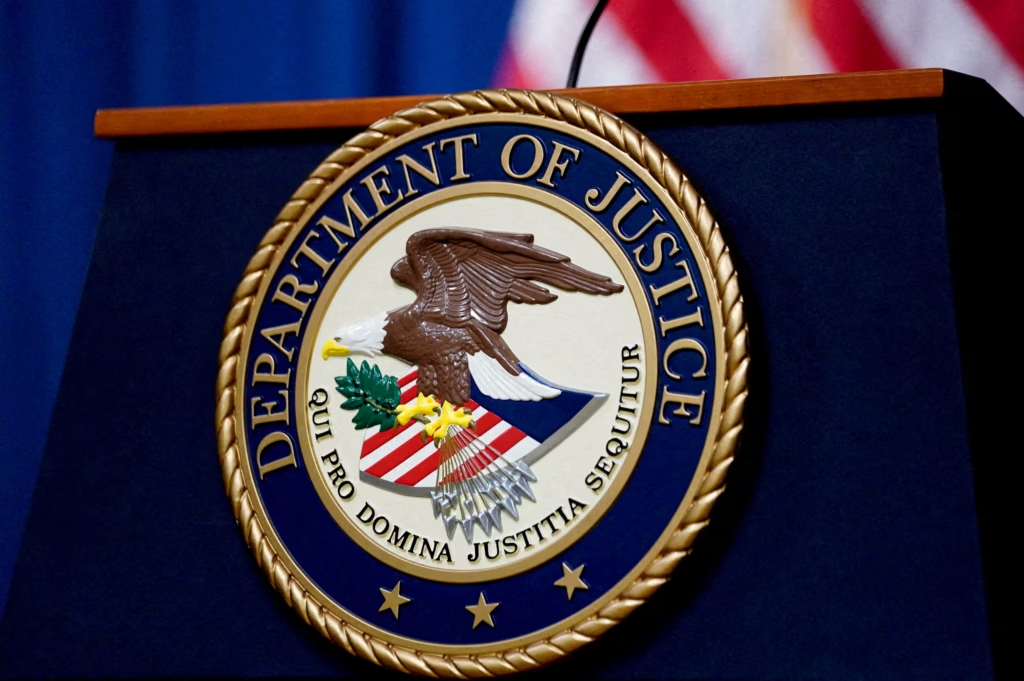
The U.S. Department of Justice (DOJ) is intensifying its antitrust scrutiny of Big Tech’s involvement in artificial intelligence, signaling a new phase in the federal government’s effort to regulate digital power. With AI now considered a critical infrastructure technology, regulators are expressing concern over market concentration, vertical integration, and potential abuses of dominance by a small handful of firms.

In early 2025, the DOJ’s Antitrust Division confirmed it had launched investigations into the partnerships and investment structures linking leading AI model developers with cloud providers and platform gatekeepers. These include scrutiny of Microsoft’s ties with OpenAI, Google’s partnerships with Anthropic and DeepMind, and Amazon’s investments in AI startups integrated into AWS services.

“When a few firms control the compute, the capital, and the customer access, we have to ask whether competition is being distorted at every layer of the stack,” said Assistant Attorney General Jonathan Kanter. “We will not allow the AI revolution to replicate the monopolies of the platform era.”

The DOJ is reportedly examining:

  • Exclusive data-sharing agreements
  • Cloud credits tied to platform loyalty
  • Preferential treatment in app stores and APIs
  • Bundled AI services in productivity software

Kanter’s division has already signaled it may challenge existing deals that involve preferential infrastructure access in exchange for model equity, such as Microsoft’s arrangement with OpenAI. Meanwhile, the Federal Trade Commission (FTC) is also pursuing parallel investigations, focusing on deceptive AI advertising and consumer harm.

The renewed antitrust agenda has received bipartisan support in Congress, with both Republican and Democratic lawmakers calling for greater oversight of how tech giants shape AI markets. A bipartisan AI Competition Act introduced in the Senate proposes stricter reporting requirements and sunset clauses for vertically integrated AI services.

Critics argue that regulators risk stifling innovation or delaying beneficial AI deployment. “Heavy-handed interventions could backfire,” said Henry Olson, policy director at the American Enterprise Institute. “But transparency and fair access are legitimate concerns.”

Advocacy groups like the Center for Humane Technology and Open Markets Institute have welcomed the DOJ’s stance. “AI concentration is not just an economic risk — it’s a democratic one,” argued Sarah Miller of the American Economic Liberties Project.

These antitrust actions mark a significant expansion of the Biden administration’s approach to tech regulation. With the 2026 elections looming, the outcomes of these cases could shape both the structure of the AI industry and the political debate over tech accountability.

🔗 Sources:


EU AI Gigafactories

The European Union is investing in a new generation of ‘AI Gigafactories’—massive facilities designed to boost regional capacity in training, testing, and deploying large-scale artificial intelligence models. These sites, modeled on semiconductor and battery gigafactories, aim to provide shared infrastructure for European companies, universities, and public institutions seeking alternatives to reliance on American and Chinese AI systems.

The initiative is part of the EU’s Digital Decade strategy and backed by the European Investment Bank, with initial funding of €2.5 billion approved in 2025. Construction has already begun on three flagship sites in Germany, France, and the Netherlands, with a fourth proposed in Central Europe to ensure balanced access across the bloc.

The gigafactories are envisioned as national and cross-border hubs for:

  • High-performance computing (HPC) clusters tailored for AI workloads
  • Secure and sovereign cloud infrastructure for model training
  • Datasets aligned with EU data protection and multilingual priorities
  • Sandboxes for regulatory testing under the EU AI Act

“These facilities will be the backbone of a new sovereign AI ecosystem,” said Margrethe Vestager, Executive Vice President of the European Commission. “They will give European innovators access to compute and data resources they currently lack.”

The move comes amid growing concerns that European firms—especially startups and public research institutions—cannot compete with U.S. tech giants who dominate compute access. According to a 2024 report by the European AI Observatory, 84% of large model development in Europe relied on infrastructure based outside the continent.

Civil society groups have called on the EU to ensure the gigafactories uphold sustainability, transparency, and fair access. “If we’re building AI at scale, it must be green and equitable,” said Clara Boucher of the Green Tech Alliance. The Commission has pledged that all gigafactories will meet EU climate goals and be powered by renewable energy.

The initiative is also intended to anchor Europe’s competitiveness in foundation model development. Several consortia—comprising startups, universities, and state-backed labs—are expected to bid for AI project slots within the facilities starting in early 2026.

“This is a bold step, but a necessary one,” said Jan Kowalski of the European AI Association. “If Europe wants to set global AI norms, we must have our own AI engines.”

🔗 Sources:

UN Geneva AI Summit July 2025

Held in July 2025 at the Palais des Nations, the UN Geneva AI Summit brought together over 2,000 participants from governments, tech companies, academia, and civil society to address the future of artificial intelligence in global governance. Framed as a critical follow-up to the UN’s Global Digital Compact consultations, the summit focused on inclusive AI strategies, regulatory coherence, and ethical alignment across regions.

UN Secretary-General António Guterres opened the summit by warning that AI’s rapid advancement outpaces regulation, posing risks to democracy, labor, and human dignity. “We are in an AI arms race that must become a peace race,” he said. “We need global guardrails rooted in the UN Charter.”

Key themes of the summit included:

  • Multilateral coordination and interoperability of AI policies
  • Capacity-building for the Global South
  • Algorithmic accountability and anti-bias mechanisms
  • Leveraging AI for sustainable development and climate action

Panel sessions explored diverse topics such as AI and human rights, the geopolitical impacts of autonomous weapons, and the role of youth and indigenous knowledge in shaping ethical AI. A notable feature was the Civil Society Assembly, which produced a joint declaration demanding greater transparency in AI governance and stronger public oversight of corporate algorithms.

UNESCO unveiled an updated implementation roadmap for its AI ethics guidelines, while the Office of the UN Tech Envoy introduced a draft accountability framework to track how states and companies comply with ethical AI principles. The UN High Commissioner for Human Rights, Volker Türk, urged all stakeholders to prioritize fairness, privacy, and meaningful consent in the deployment of AI tools.

Several new initiatives were launched:

  • The Global AI Observatory, to be hosted by UNIDIR, which will monitor AI trends, risks, and governance gaps
  • A cross-UN partnership with ITU, UNDP, and WIPO to support capacity-building in low- and middle-income countries
  • A ‘People’s Panel on AI,’ a rotating citizen assembly to advise UN agencies on tech policy

The Geneva AI Summit was widely seen as a pivotal moment to cement the UN’s leadership in global AI discourse. However, critiques were raised over the voluntary nature of many proposed frameworks. “Without enforcement, the risks remain,” said Renata Ávila, CEO of the Open Knowledge Foundation.

The UN plans to integrate summit outcomes into negotiations at the 2025 Summit of the Future, where the Global Digital Compact will be finalized. Many expect AI to feature prominently in the Compact’s final language.

🔗 Sources:

EU AI Timeline Enforced, Pushback from Businesses

The European Commission has confirmed it will enforce the timeline of the EU Artificial Intelligence Act, despite mounting calls from industry leaders to delay implementation. The landmark regulation, adopted in 2024, sets a comprehensive legal framework for AI systems operating within the European Union, and is expected to come into force gradually starting in August 2025.

Tech executives from across the continent — including leaders from Airbus, Siemens, and SAP — have signed a joint letter warning that the law’s complexity and strict risk-based classification could hinder innovation and create excessive compliance burdens. “Europe risks falling behind in global AI development,” the letter stated, calling for a 12-month pause on enforcement to give companies more time to prepare.

The Commission rejected the proposal, citing extensive consultation and transitional measures already built into the regulation. “We believe the timeline is appropriate and proportionate,” said Internal Market Commissioner Thierry Breton. “We are providing clarity, legal certainty, and a fair playing field for responsible AI.”

The AI Act categorizes systems into four risk levels — unacceptable, high-risk, limited, and minimal — and imposes obligations based on those categories. High-risk systems, such as AI used in employment, healthcare, and law enforcement, must comply with strict data governance, transparency, and human oversight requirements.

Developers of general-purpose AI (GPAI) models — like large language models — are also subject to new transparency and safety provisions under a separate code of practice, which is still under negotiation and expected to be released by the end of 2025. The phased approach will see full compliance for GPAI developers and high-risk AI providers by August 2026.

Startups and small businesses have raised concerns about access to compliance tools and regulatory guidance. The European Commission has pledged to roll out a technical sandbox and funding support to help SMEs adapt.

Meanwhile, civil society groups have welcomed the Commission’s resolve. “The tech industry always asks for more time,” said Sarah Chander of European Digital Rights (EDRi). “But people affected by biased algorithms and opaque systems can’t afford to wait another year for safeguards.”

The European AI Office, set to be fully operational by early 2026, will oversee enforcement, coordinate with national authorities, and support consistent application of the Act across member states.

Analysts say the outcome will shape the global trajectory of AI regulation. With the U.S., UK, and China watching closely, the EU’s decision to stay the course could either position it as a global leader in trustworthy AI — or weigh down its tech sector in regulatory complexity.

WFUNA, UNAs Join in Partnership with the Bits for Atoms Alliance

In a major step forward for inclusive global digital governance, the World Federation of United Nations Associations (WFUNA), in cooperation with several national United Nations Associations (UNAs), has joined efforts under the Bits for Atoms Alliance. This new platform seeks to mobilize a broad coalition of civil society, academia, and tech innovators to shape the future of AI and emerging technologies through ethical, inclusive, and human-centered principles.

The Bits for Atoms Alliance (B4A) derives its name from the convergence of the digital and physical — bits symbolizing data and code, and atoms representing the real-world impact of technology. According to WFUNA officials, the alliance is inspired by the UN’s call for a Global Digital Compact and the growing urgency to democratize access to AI tools and frameworks.

“We recognized a gap between global digital policymaking and local empowerment,” said Lisa Montoya, one of the UNA representatives involved in the founding committee. “B4A aims to connect those dots — to support digital capacity-building on the ground while also contributing to the shaping of international AI norms.”

The alliance plans to work on three key fronts: (1) Education and outreach on AI literacy, especially in underserved regions; (2) Policy engagement with the UN, the EU, and other multilateral bodies; and (3) A digital commons initiative to provide open-source tools, datasets, and community training hubs.

Its steering committee includes representatives from UNA-UK, UNA-Georgia, UNA-Kenya, and WFUNA Youth delegates. The group is also in dialogue with UNESCO’s ethics of AI division and the Office of the Secretary-General’s Envoy on Technology.

The Bits for Atoms Alliance is expected to host its first global forum later this year, with working groups focusing on AI and education, digital rights, and the role of civic tech. Early partners include research centers in the Global South, youth innovation labs, and grassroots media platforms.

🔗 Sources: